

Hey there! As a supplier of aluminium foil rewinder machines, I've gotten tons of questions about how these nifty machines adjust the guiding position of the foil. So, I thought I'd break it down in this blog post, sharing some insights and tips that might be useful for you in your operations.
First off, let's understand why adjusting the guiding position of the foil is so crucial. When you're rewinding aluminium foil, you want it to be wound neatly and precisely. Any misalignment can lead to all sorts of problems, like uneven winding, wrinkles, or even tears in the foil. This not only affects the quality of the final product but can also cause downtime in your production line.
Now, let's dive into the different ways an aluminium foil rewinder machine can adjust the guiding position of the foil.
Mechanical Adjustment
One of the most basic methods is mechanical adjustment. Most aluminium foil rewinder machines come with some sort of mechanical guiding system. This usually involves adjustable rollers or guides that can be manually moved to change the path of the foil.
For example, there might be side guides that can be tightened or loosened to control the lateral movement of the foil. By adjusting these guides, you can ensure that the foil stays centered as it moves through the rewinding process. It's a simple and effective way to make small adjustments, but it does require some hands - on work.
Another mechanical adjustment option is the use of adjustable tension rollers. These rollers can be adjusted to change the tension on the foil at different points in the rewinding process. By increasing or decreasing the tension, you can influence the way the foil is guided. For instance, if the foil is drifting to one side, you can increase the tension on that side to pull it back into place.
Sensor - Based Adjustment
In more advanced aluminium foil rewinder machines, sensor - based adjustment systems are used. These systems use sensors to detect the position of the foil and then automatically make adjustments to keep it on track.
There are different types of sensors that can be used. Optical sensors, for example, can detect the edges of the foil. If the sensor detects that the foil is moving out of position, it sends a signal to the machine's control system. The control system then adjusts the guiding mechanism, such as the side guides or the tension rollers, to correct the position of the foil.

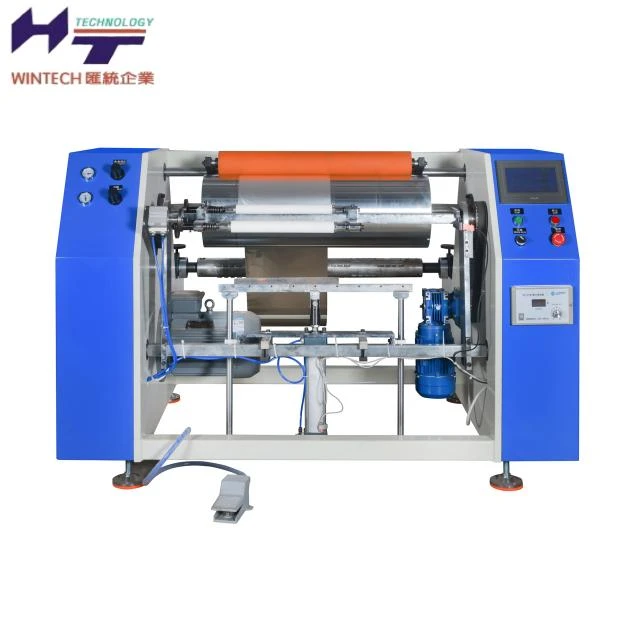
Ultrasonic sensors are another option. These sensors work by emitting ultrasonic waves and measuring the time it takes for the waves to bounce back. By analyzing the reflected waves, the sensor can determine the position of the foil. Similar to optical sensors, if the foil is out of position, the ultrasonic sensor will trigger the control system to make the necessary adjustments.
Computer - Controlled Adjustment
With the advancement of technology, many modern aluminium foil rewinder machines are now equipped with computer - controlled adjustment systems. These systems offer a high level of precision and automation.
The computer control system can be programmed to maintain a specific guiding position for the foil. It can also store different settings for different types of foil or rewinding requirements. For example, if you're working with a thinner foil, you can set the system to use a different guiding strategy compared to when you're working with a thicker foil.
The computer control system continuously monitors the position of the foil using sensors and makes real - time adjustments. This means that even if there are small variations in the speed or tension of the foil during the rewinding process, the system can quickly correct the guiding position to ensure a consistent and high - quality rewinding result.
Factors Affecting Guiding Position Adjustment
There are several factors that can affect the adjustment of the guiding position of the foil. The thickness of the foil is one important factor. Thinner foils are more prone to wrinkling and misalignment, so they may require more precise guiding adjustments. On the other hand, thicker foils are generally more rigid and may be easier to guide, but they still need to be properly aligned to avoid uneven winding.
The speed of the rewinding process also plays a role. At higher speeds, the foil is more likely to move out of position due to factors like air resistance and vibrations. Therefore, the guiding system needs to be more responsive and accurate when the machine is operating at high speeds.
The quality of the foil itself can also affect the guiding position. If the foil has irregularities, such as uneven edges or thickness variations, it can be more difficult to guide. In such cases, the guiding system may need to make more frequent and significant adjustments to keep the foil in place.
Our Product Range
We offer a wide range of aluminium foil rewinder machines to meet different customer needs. If you're looking for a high - performance machine, check out our six - shafts Silicon Paper Rewinding Machine. It's designed with advanced guiding systems to ensure precise and efficient rewinding of silicon paper and aluminium foil.
For those on a budget or with smaller - scale operations, our Three Shafts Aluminum Foil Rewinding Machine is a great option. It provides reliable performance and basic guiding adjustment features at an affordable price.
And if you prefer a semi - automated solution, our Semi - automatic Aluminum Foil Rewinding Machine offers a good balance between manual control and automation. It allows you to make adjustments as needed during the rewinding process.
Conclusion
Adjusting the guiding position of the foil in an aluminium foil rewinder machine is a critical step in ensuring the quality of the rewound product. Whether you're using mechanical adjustment, sensor - based adjustment, or computer - controlled adjustment, there are various methods available to keep the foil on track.
If you're in the market for an aluminium foil rewinder machine or need more information about how to adjust the guiding position, don't hesitate to reach out. We're here to help you find the right solution for your specific needs. Contact us today to start a conversation about your requirements and let's see how we can improve your aluminium foil rewinding operations.
References
- Industry standards for aluminium foil rewinding
- Manufacturer's manuals for aluminium foil rewinder machines
- Technical articles on foil guiding systems in the packaging industry